Baldur's Gate 3
En mis juegos


A classic role-playing game (CPRG) with an isometric camera, distinguished by interactive, immersive locations and gameplay that offers plenty of choices. Go... Leer más
Todos los idiomas (15)
Deutsch: interfaz, subtítulos
Español: interfaz, subtítulos
Español (Latinoamérica): interfaz, subtítulos
Français: interfaz, subtítulos
Italiano: interfaz, subtítulos
日本語: interfaz, subtítulos
한국어: interfaz, subtítulos
Polski: interfaz, subtítulos
Português (Brasil): interfaz, subtítulos
Русский: interfaz, subtítulos
Türkçe: interfaz, subtítulos
Українська: interfaz, subtítulos
简体中文: interfaz, subtítulos
繁體中文: interfaz, subtítulos
A classic role-playing game (CPRG) with an isometric camera, distinguished by interactive, immersive locations and gameplay that offers plenty of choices. Go wherever you want, do whatever you want, and complete quests however you want. Combat is strictly turn-based, but time passes in real time while you move. Actions are resolved by rolling a twenty-sided die, following the rules of Dungeons & Dragons 5, but the game design doesn’t try to cater to hardcore D&D fans, simplifying everything for newcomers. The story is presented in a modern style, with plenty of cinematic in-engine scenes and CGI videos.
Fascinating Faerûn

The Forgotten Realms universe includes practically every element of classic fantasy and is rich in detail. Magic of various types and elements. Flexible combat featuring one- and two-handed melee weapons, bows and crossbows, and hidden blades. A wide variety of races (elves, dwarves, orcs, goblins, and so on) and fantasy creatures (dragons, demons, vampires, elementals). A pantheon of local gods who influence the fates and motives of the people.
The adventure unfolds on the continent of Faerûn, in its warmer regions of picturesque meadows and dense forests, with densely populated villages and large cities. Baldur's Gate 3 takes place across vast territories: the player will visit a wide variety of places in Faerûn, descend into the Underdark, and venture into other planes. The level designers have chosen the right atmosphere for every location—whether it’s a seaport, a gnome foundry, a demon realm, or rotten swamps, everything feels authentic. Some things are also changed by mods.
The open world is divided into large areas corresponding to the current act of the main story. All levels are handcrafted, carefully decorated, and full of life. Baldur’s Gate itself—a city of opportunity and failure, saints and sinners—only appears in the final act. This part of the world is grand, and every corner has its own stories and activities. NPCs wander everywhere, and you can talk to anyone.
Story

The events of Baldur's Gate 3 take place 120 years after the finale of Baldur's Gate 2: Enhanced Edition. Those days and the conflict with the god Bhaal have become legend. Faerûn now faces different problems, but an ancient evil is rising from the shadows once more, quietly disrupting what seemed to be an established order. Faerûn is once again threatened with falling into darkness, heralded by a devastating invasion of the squid-like illithids: a high-tech race of brain-eaters from another dimension.
The story’s opening is far from momentous. Through a series of circumstances, the protagonist is captured by an illithid ship, and a tadpole is implanted in their brain. It’s about to transform the hero into a mollusk with horrifying tentacles—but a stroke of luck lets them escape the ship early. What begins with the simple goal of “getting rid of the parasite” gradually grows into an epic adventure, with the stakes of your decisions rising to encompass all of Faerûn.
Baldur's Gate 3’s story can’t be neatly described as dark or uplifting, tense or emotionless. It all depends on your choices and whether you accept their consequences. With more than 17,000 choices, players shape the story’s trajectory, and every playthrough will be unique: with different friends and foes, relationships between characters, dialogue, quests, and endings. The story is full of unpredictable twists that lead to radically different outcomes.
The story is so complex that even deliberately killing companions or important NPCs won’t bring your playthrough to a halt. Main, side, and other quests are seamlessly interwoven: progressing through the story unlocks side quests, while completing an optional task or finding an item can lead to an entire story arc. The latter, however, is easy to miss. And all this is in addition to unique events and quests that arise from the circumstances of your playthrough.
Baldur's Gate 3’s story unfolds over three acts and impresses with its direction. Key story moments and interactions between characters are presented as polished animated scenes, drawing you deeper into the events. As soon as one intrigue is resolved, another often takes its place, keeping you hooked. And to get the full picture of what’s going on, simply watching won’t be enough—you’ll have to read every source. The direction of the scenes and staging of the dialogue, combined with voice acting and facial motion capture, present a lot of text (narrative) in a more convenient form for the player compared to other games in the genre.
Protagonist and Companions

Baldur's Gate 3 offers both premade heroes and the option to create your own. The character creator is vast. You can choose your appearance, physical traits, facial and body features, personality, and backstory.
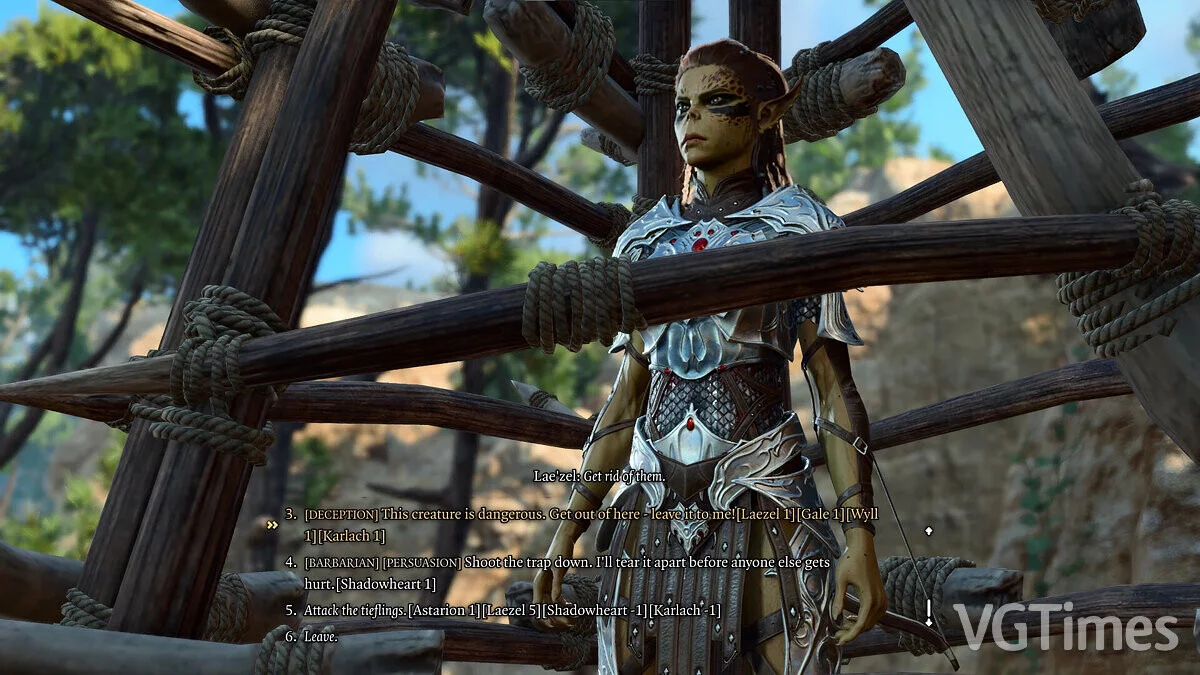
A hero’s chosen race and subrace grant them unique traits and abilities. Some see better in the dark, others heal wounds faster, while others are simply physically stronger, and so on. They also directly affect role-playing, because other characters in Faerûn perceive them differently. A tiefling with fiendish blood might be challenged to a duel where an elf would be welcomed with open arms. Thus, choosing a race opens up unique story options and dialogue, making the gameplay experience even more varied.
The dozen or so main classes determine a hero’s abilities and combat skills, directly influencing their playstyle: a Tank absorbs damage, a Paladin charges into the fray, a Bard provokes enemies, a Druid turns into a bear, and a Wizard casts spells. There are also subclasses, which offer further specializations and unique abilities. Each character has six core attributes: Strength, Dexterity, Constitution, Intelligence, Wisdom, and Charisma. One is considered their primary attribute, and another their secondary one.
As you progress through Baldur's Gate 3, you’ll meet a diverse cast of companions who, as is standard for the genre, can join your party. Each is a unique individual with a fleshed-out backstory, motivations and moral compass, as well as skills and abilities. Which makes them an important asset when making decisions during checks (you can switch to a companion in dialogue), interacting with the world around you, or in combat (the check is handled by whichever party member is most skilled at it).
You can’t bring all your companions along at once, and some are mutually exclusive. Others may disapprove of certain choices made by the protagonist and leave the party. You can influence your relationships by completing a companion’s often challenging personal quest . The more cohesive your party, the better, as your choice of companions will have a major impact on the story.
Single-player

Baldur's Gate 3 follows the genre’s conventions. You move through each level as a group, immediately engage obvious enemies in combat, and try to negotiate with everyone else through persuasion, intimidation, or money. Along the way, you explore the level and “vacuum up” everything you find, adding it to your own and your companions’ inventories. Items are divided by rarity and their stats affect one of the hero’s six core attributes, significantly shaping your build by adding abilities and effects to attacks or spells.
How you deal with a particular group of enemies is up to your imagination—there are always several options. In combat, friends and foes each have a set number of actions per turn, including movement, a main attack, special actions, and using abilities. You can only use the latter a couple of times per fight, since combat has no “mana bar” as such. The game engine takes vertical positioning into account, letting you kick or shove enemies off ledges.
Interactive objects in a level can turn the tide of battle. You can grab an oil barrel and hurl it at enemies, or coat your sword with oil and set it alight to add fire damage. This encourages you to use the environment and physics in combat rather than relying solely on tactics. Melee classes follow modified rules, making them no weaker than wizards. The whims of chance that are characteristic of the D&D system also hold sway in Baldur's Gate: any action can end in either success or critical failure.
Restoring health and abilities happens at camp, whose design reflects the surrounding area. Stop in a forest, and the camp takes on a woodland atmosphere; enter a city, and the camp instantly “dresses up” in urban surroundings. Aside from socializing and managing your inventory and party, there’s nothing else to do at camp.
Baldur's Gate 3 offers a range of engaging activities: solving puzzles and other logic challenges; gathering resources and recipes to craft potions, elixirs, weapon buffs, and other consumables; and using stealth mode, which is always available and lets you complete objectives more efficiently. Completing a quest through combat, stealth, or diplomacy often leads to different outcomes, which may come back to haunt you someday.
Progression is also standard: defeat enemies, complete quests, explore Faerûn, and pass difficult checks, among other things, and the whole party gains experience. The hero and companions earn the same amount of experience from all sources. Once they’ve gained enough, characters level up, unlocking skill points to spend on their attributes, as well as new abilities. You can also develop a second class (multiclassing). Replayability is extremely high.
The game remains a role-playing game without being bogged down by unnecessary rules to balance the difficulty, though a couple of hours may not be enough to get the hang of it. Find the best character builds and individual game mechanics in our guides section.
Co-op gameplay

Baldur's Gate 3 can be played through in co-op with a party of 2 to 4 players, creating unique new heroes or bringing in characters from another party. Notably, the gameplay doesn’t require everyone to stick together: each player is a protagonist, free to do whatever they want within the game world. One can explore a dungeon, another can explore the world, and a third can cause chaos while talking to characters.
However, co-op is designed to create an experience equivalent to playing D&D with a Dungeon Master. All turns are agreed upon, and incoming information (journal entries, the mini-map, discoveries, and recipes) is shared by everyone playing together. Each player is rewarded with “Inspiration points” for actions that suit their role, allowing them to reroll the dice if they fail a dialogue option.
Friends can see what is happening in the game and what choices other players make in dialogue options. Alternatively, they can vote on a decision. The host can also keep control of dialogue options. Some scenes, such as romantic ones, will automatically be private, though they can be shared with group members.
There is an alternative “two-player” game mode in which both players are in the same room. The screen will split in half, and each player will play on their own half. The rules are the same as in regular co-op.
Ofertas de tiendas y descuentos


Requisitos del sistema y prueba de PC
- Windows 10 64-bit
- Procesador: Intel Core i5-4690
- Memoria RAM: 8 GB
- Espacio libre: 150 GB
- VRAM: 4 GB
- Tarjeta gráfica: GeForce GTX 970; Radeon RX 480
- DirectX: 11
- Keyboard, Mouse
- Windows 10 64-bit
- Procesador: Intel Core i7-8700K
- Memoria RAM: 16 GB
- Espacio libre: 150 GB
- VRAM: 8 GB
- Tarjeta gráfica: GeForce RTX 2060 SUPER; Radeon RX 5700 XT
- DirectX: 11
- Keyboard, Mouse



Reseñas y calificaciones

¡Lo mejor que ha salido en los últimos años en el género RPG! Te atrae como arenas movedizas y cada hora se vuelve más interesante. Personajes vivos detallados, historia, combate, ¡puedes pasar cientos de horas en este juego!
Лучшее что выходило на этот свет за последние годы в жанре рпг! Затягивает как в зыбучие пески ,и с каждым часом все интереснее. Детальные живые персонажи ,лор ,бои,в этой игре можно провести сотни часов !

Realmente no me gustan los juegos de rol, pero este juego es digno de ser llamado una obra maestra, sus personajes y su historia están bien escritos, y la mejor chica es Karlakh. De las desventajas, hubo varios errores y la cámara se cayó bajo tierra durante las escenas. Recomiendo el juego a todos.
Не особо люблю РПГ но это игра достойно называется шедевром хорошо прописанные персонажи и лор, а самая лучшая девочка это Карлах. Из минусов были несколько багов и камера проваливалась подпол во время катсцен.Игра хорошо всем советую

Las figuras son demasiado pequeñas. ¡Los ojos duelen al rato! Un sistema de combate aburrido y complicado, y por unos 50 €, demasiado caro para un juego tan antiguo.
Figuren zu klein.Nach ner zeit Augenschmerzen!!!Langweiliges umständliches kampfsysthem und mit ca 50€ für son altes spiel viel zu teuer!

Después de pasar 200 horas jugando con y sin mods, es simplemente un juego maravilloso, puedes volver a jugarlo una y otra vez, ¡lo recomiendo a todo el mundo!
проведя в игре 200 часов играя с модами и без просто прекрасная игра можно переигрывать в неё вечно , всем советую!!

El mejor juego de rol que he jugado, después de Skyrim, claro. Pero probablemente sea por las mecánicas de D&D, que no me gustan mucho.
Лучшее RPG во что я играл, после Скайрима конечно. Но тут наверное из за DND механик которые мне не очень нравиться.


