Box Knight Review — A Roguelike About a Knight With a Box on His Head
8.0 Anastasiia Popova
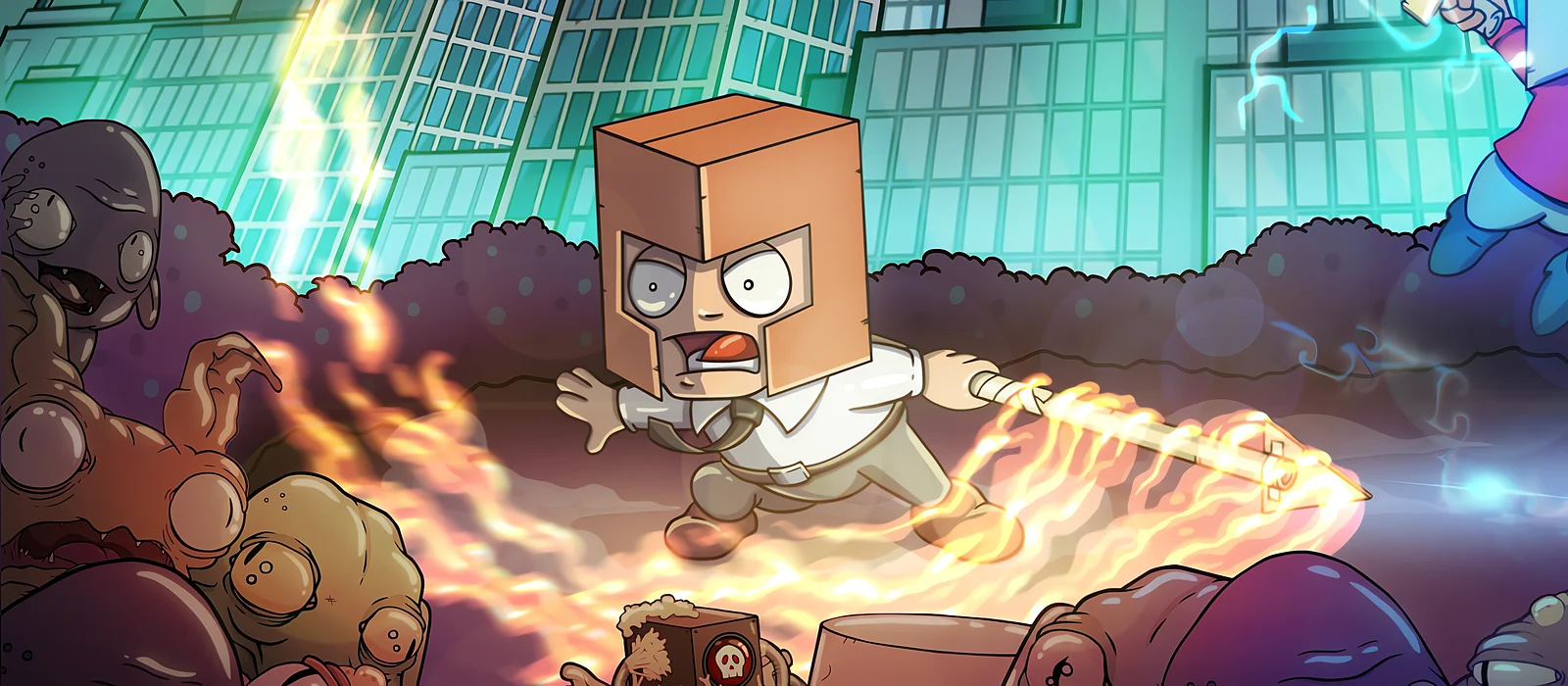
The clock ticks past five, an office worker puts a cardboard box on their head, and off we go. A minute ago you were sitting somewhere among the desks and corporate gloom, and now you're running through an office tower, hacking at monsters and trying not to lose your ult to a stray poke. Because the ult here charges fast, literally in a couple of attacks, but drops to zero the moment anything so much as touches you.
Box Knight sells its main joke pretty well. The office has turned into a dark place, the employees have become monsters, and after the workday you become the Box Knight and go sort it all out. You climb floor after floor, clear rooms, drink beer to heal, then fight a boss. Then again. The game doesn't spend long explaining why a guy in a box has to save the company. Thank goodness for that.
Platform: PC (AMD Ryzen 9 9950X3D 4.3 GHz, NVIDIA GeForce RTX 5080, 64 GB RAM);
Playtime: 3 hours.
Fighting in a Box Feels Good
The controls turned out to be really pleasant. Left mouse button is your basic attack. Hold the right one for a different attack. You can jump and strike from above, and you can dodge with Shift. There are abilities, and there's a super attack on Q.
The downward strike is especially useful: it deals damage and stuns the enemy. You walk into a room, and something is already crawling, flailing, flying and climbing out of every corner: you jump, strike from above, and get a second to breathe. Then someone walks out wearing a helmet, and your go-to move suddenly stops working. An enemy in a helmet doesn't get stunned by a downward strike.

At first, the Q super attack feels almost like a consumable: you build it up quickly with regular hits, press it, knock someone out. Then you realize there's no point in hoarding it. The ult drops from any hit, and there are plenty of enemies here. It's easier to press it while you can than to run around with a full bar hoping that this time, surely, nobody will graze you.

The problem is that the ult hits a single target. With two or three enemies on screen, that's fine. When there's a crowd around you and you urgently need to take out one specific nasty thing, the game usually picks the nearest enemy. So you've been saving up that Q, waiting for the right moment, you run up to the vile flying eyeworm that keeps spawning small mobs, press the button, and the Box Knight gracefully slams into some random scrub next to it.
I'd like at least a slightly more convenient way to choose a target. Not necessarily mouse aiming, and no need for a separate pause with a menu. Just so the character doesn't decide for me who's more important to hit right now. Or so the attack covers an area. Because in a crowd it sometimes feels like a "maybe I'll get lucky" button.
Eyeworm, Please Die First
At first, the enemies seem pretty simple. You run around, dodge, poke with your sword, sometimes jump in from above. Then the same creatures start showing up, only buffed. One has put on a helmet. Another has picked up some new nasty trick. A third heals the rest. A fourth buffs the crowd. And suddenly a room you could have cleared on autopilot a minute ago turns into a bit of a problem.

The most annoying type is the flying eyed worm. I never came up with a more decent name for it. It keeps rising and sinking, constantly summoning regular little enemies. It's irritating enough on its own. But when there's also a mob nearby that buffs the others, it turns into a real crush: small fry pour in, damage comes more often, you run out of space, and you can simply get poked to death.

I worked out a plan for it pretty quickly. I wait for the thing to get into a convenient position, knock it down with a downward strike using Shift and the right mouse button, stun it a little. Then I immediately hit Q. The ult is single-target, and this is exactly the kind of target it should take out before it summons another dozen parasites. The rest can be poked down later somehow.

Later you get enemies that have to be hit from behind. You can whack them in the face all you want, but the damage doesn't go through. You have to circle around, find the angle, spin around the room, while the others aren't exactly standing still and waiting. These are the moments that make the fights a bit more tense. You see one of these enemies, try to get around it, and right next to it there's already a healing mob, a buffing mob and the same old eyeworm. That's when the box on your head becomes almost a work requirement.

The bosses at the end of each floor repeat. On the first floor of my third run, the same boss was waiting for me as in the previous two. On the plus side, you get used to it: you learn when it's better not to go in, where to leave yourself room to dodge, and when not to waste your ult. At least these fights don't boil down to clicking a health bar away.
¿Qué tipo de roguelike prefieres?
Roulette After the Fight
After every room, an ability roulette appears. It can offer one to three options, and the number depends on how you fought in the room. If you ran in circles, dodged a lot and chipped away at enemies bit by bit, the choice will be smaller. If you properly got into the crowd and cut everyone down fast, the meter fills up, and the roulette gives you more options.

The game doesn't seem to leave you with no ability at all: even if you played the room really sluggishly, something will drop. That's a lifesaver. The abilities are mostly about elements and boosting your attacks. Regular strikes can be turned into ice, fire or electric ones, and there's something similar for special attacks. The ult, as far as I could tell, lives a life of its own. Whatever it was, that's how it stays.
I started collecting ice abilities almost right away. In games like this, freezing is usually more useful than fire, and here it pulls you through really well too. A crowd rushes into the room, a few enemies freeze from my attacks and stay frozen even after being hit. You can calmly deal with someone else without trying to keep track of every body on screen at once.
Near the end of my run, I got a truly nasty thing (in a good way): you freeze enemies, kill one of them, and the neighboring frozen ones die too. There were lots of mobs in the room. I froze them, hit one, and they started popping one after another. Boom-boom-boom, like balloons. Moments like that are a feast for the eyes.
There's a Prestige tab where you can pick a specialization in fire, ice or lightning. It unlocks through bosses: they drop artifacts, and the artifacts are traded for these very "prestiges." Only one can be active at a time. Fire Specialist gives fire points and raises the chance of seeing fire abilities, and there are Frozen and Zap with the same general idea. If you like putting builds together and starting over after a failed run, we have a piece on the best roguelike and roguelite games.

I tried two options but didn't feel any huge difference. I still liked ice more, because crowd control decides a lot here. When enemies are frozen, at least you're not running around the room like someone who accidentally came to the office on a day off and found the door locked behind them.
Beer, a Banana and the Accounting of Death
Between rooms, you can heal with beer. You carry one bottle, so you can't just drown every scratch. Around the map, you'll run into employees in some kind of murky state. You walk up, give them the currency you've collected during the run, and choose a reward. Most often I needed another bottle of beer. Because in long fights your health drains fast, and your healing runs out even faster.

You can also get Boost XP there. Judging by the name, you should be getting more experience after it, but I didn't notice any difference by eye. Maybe the numbers really were growing faster, and I just wasn't keeping track. Beer is much clearer in that regard: you drink, you feel better. Sometimes that's enough.

Outside of runs, a different currency builds up. You clear rooms, get rewards, save up coins, and can go to the shop. There are three types of weapons: a two-handed sword, a regular sword and a spear. I tried them all and beat the game with the spear. I liked it the most. With a spear it's easier to keep your distance, and when a room is packed with enemies, an extra step between you and the crowd is worth more than any pretty animation.

There are helmets and outfits, and they're not just cosmetic. In the final stretch, I bought a banana costume: it gave +10% to health and +10% to defense. So that's how I went through the office tower: a banana with a spear and a box on its head. Solid career growth.

There's also a talent tree that opens up by level. Up to level 20, you can take upgrades for damage, defense, dodging and stun. Points are earned during fights, or at least that's how it looked: you fight, and something gradually builds up. All this progression is pretty simple and clear, with no attempt to make you sit in menus longer than in the actual room with the monsters.

There are three difficulty levels. I played on Normal. There's Hardcore and a locked Corporate Hell. Judging by the description, Corporate Hell opens after you beat Hardcore: the enemies there are tankier, hit harder, and all become elite. And if your personal Corporate Hell starts as early as the system requirements, our selection of the most optimized PC games will come in handy.

What annoyed me the most, though, was when a fight dragged on and more monsters kept coming. You've already finished off the main crowd, you're already waiting for the ability roulette, you already want to move on, but the game still keeps you in the office. In those minutes, the combat, which feels lively at first, starts to chew on itself a little.
¿Qué es lo que más te molesta?
The Knight Made It to the Basement
My first two runs turned out almost identical in terms of rooms. Literally one to one. That's a strange start for a roguelike: you run, recognize the room, walk into the next one, and recognize that one too. On the third run, the rooms finally changed. The enemies do evolve as you progress, with new types and buffed versions of old ones being added, so the process never gets completely monotonous. But during those first two runs, I was already starting to suspect the office tower was simply saving money on redesigns. If you want something that isn't too demanding on hardware, you can also check out our selection of the best low-end PC and laptop games.

I did beat the final boss in the end. The whole time before that, I'd been climbing up the tower, and then the game put me in an elevator and sent me all the way down. In the basement, I found the first Box Knight.

Then I started another run, this time with the two-handed sword. The enemies got stronger, and after beating the game they started appearing all mixed together, as if the game had stopped neatly sorting them by floor. Before, the difficulty ramped up more or less gradually, but now creatures from different parts of the tower can show up in the same room. Things got livelier.

***
The whole playthrough took me three hours. If you're looking for something small that won't take dozens of hours, you can also check out our selection of the best video games for people with short attention spans. At the same time, for some reason not a single achievement unlocked. Not even the ones that should have triggered on their own, like clearing a room or something else very basic. On the other hand, the controls are good. The fights are mostly enjoyable too, especially when you manage to drop the eyeworm, freeze the crowd and blow it apart with a chain of deaths. And then you move on in a banana costume, with a bottle of beer in your pocket and a box on your head.